- Steven's Saturday Seven
- Posts
- ✅ Steven's Saturday Seven - 20 January 2024
✅ Steven's Saturday Seven - 20 January 2024
You Won't Believe How Extra British Tanks Are, The Powerful Practice Perspective, and The Friction Between You And Productivity (Part 2 Of 2)

Steven Sanders
January 20, 2024
Happy Saturday, friend!
We’re back again with another edition of Productivity + Habits + Fun
😃 Fun Fact of the Week
British military tanks are equipped to make tea.

Believe it or not, there’s a boiling vessel within these tanks that allow soldiers to have their tea.
🐦 Tweet of the Week
Want to form new habits?
Prioritize practice as your first habit, and watch everything else fall into place.
— Brian Holden (@brianjholden)
1:07 PM • Oct 28, 2023
This is a really great perspective.
Those first iterations are almost exclusively just getting your mind and body used to new stimuli.
By framing it as practice, the high stakes of "This has to be perfect" aren't present.
Do you think Bach was a maestro the first time he played piano?
What about all-star athletes like Jordan and Messi?
They sucked at the beginning, but through relentless and consistent practice, they forged themselves into powerful inspirations.
So what’s a new habit you’d like to form?
💪 Featured Productivity Tip (Part 2 of 2)
This is one from Mr James Clear and his book Atomic Habits.
Friction: the resistance experienced before beginning an action
Have you ever noticed that some actions are easier to begin than others?
Last week we discussed reducing friction to help make the good habits you want to develop easier to act on.
Now let’s play the reverse and increase friction on the habits we want to break or limit.
James Clear himself lists these as points of friction to decrease your TV time:
unplug the TV after you’re done using it
remove the batteries from the remote
have a rule that you can’t watch Netflix until you name the exact show you want to see (to prevent mindlessly searching for nothing and truly wasting time)
Here is one I do specifically to help me focus on my top tasks in the morning while working:
I turn my phone completely off AND leave it in my bedroom.
This creates two barriers:
I have to get up and walk into the bed room
I have to actually turn the phone on and wait for it to do its thing
Just thinking about that extra inconvenience makes it so much easier to stay at my desk and keep working.
If you look back, you’ll see that this was mentioned in last week’s newsletter.
In the example goal of “only eating healthy snacks,” the first tip was to remove the unhealthy snacks from the house entirely.
Do you see how you can engineer inconveniences to help you meet your goals?
What ideas do you have to implement this?
🕰️ The Daily Routines of Famous Creatives
Haruki Murakami: slept from 9pm to 4am, 8 hours of creative work in a single block, 1 hour of exercise after working, and the rest of the day was for food and leisure
Maya Angelou: slept from 10pm to 5:30am, a short breakfast at 6am, 8 hours of creative work in one block with another half hour block in the evening, the rest of her day was broadly for food and leisure
Charles Dickens: slept from 12am to 7am, breakfast from 8am to 9am, 5 hours of creative work in a single block, exercise from 2pm to 5pm, and the rest of his day was for food and recreation
As you can see, there's no one-size-fits all approach to structuring your day.
These folks found their way to get the most gains for what worked for them.
Can you say the same about your day?
If you think you can do better, but you don't know how to start, the first step is simple:
Reply to this email, and I'll see how I can help you.
📈 Investment Themes Since 1950
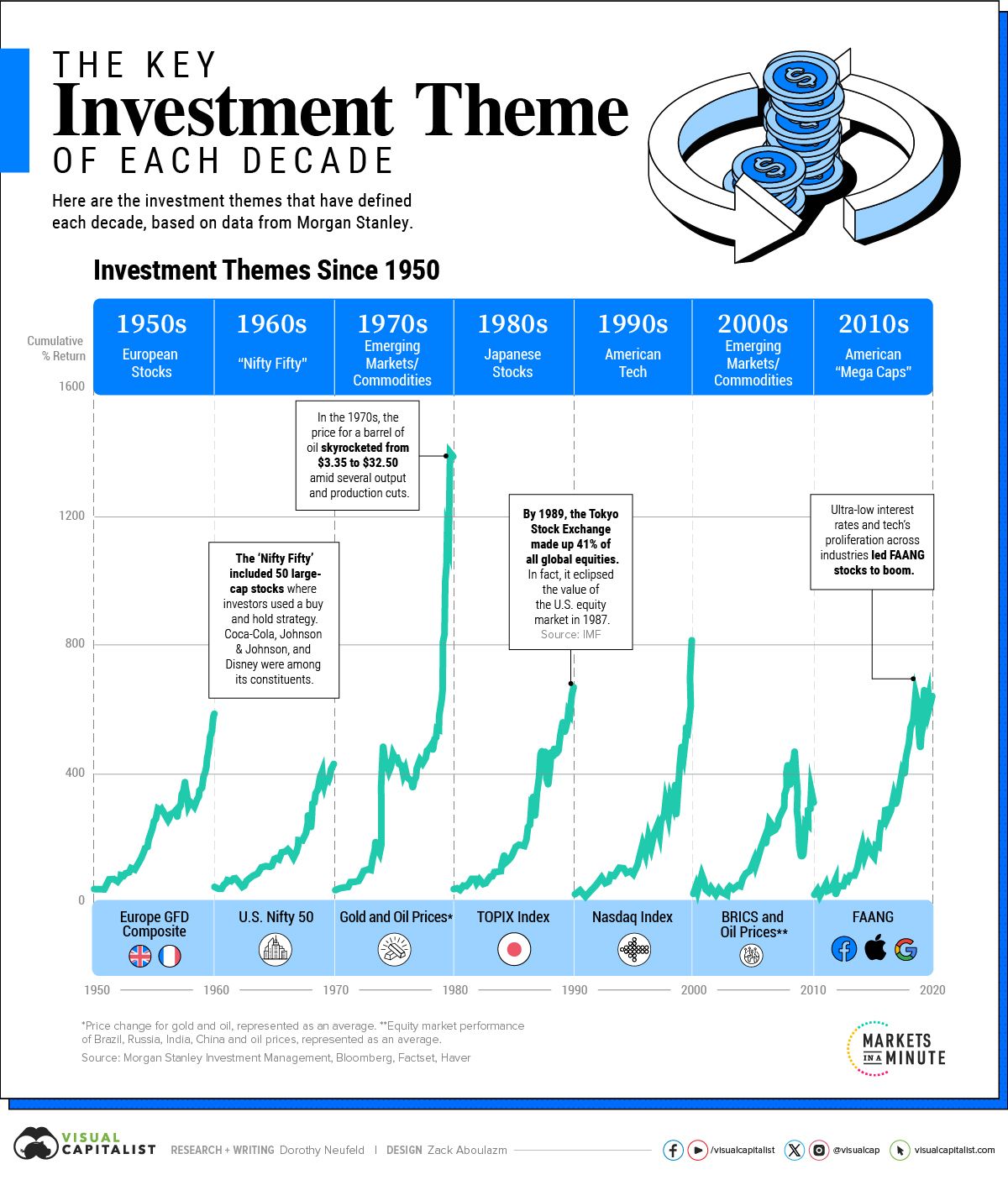
This is so interesting to me - to see how things changed decade to decade.
For my investments friends out there: What major theme do you predict for 2021 - 2030?
🤔 Decision-making Idea
The Google Effect: Because it’s now so easy to look up anything we want to know, we tend to be forgetful of things that used to be commonly known.
Examples: answers to trivia questions, addresses and phone numbers, the definition of a word you just learned
To be fair, there’s an argument to be made that this is a positive change.
Why take up “space” in our brain with trivial information when we can sharpen the skill of quickly referencing something?
We’re transitioning into an age of data curation.
There’s so much information out there, that it would be impossible to hold it all in our minds.
Why not shift gears and become specialists in finding the info we need?
But what do you think?
What things should we endeavor to always keep in mind?
🧠 Quote of the Week
Don’t compare your progress to that of others. We need our own time to travel our own distance.
What I think:
This was a very hard lesson for me to learn when I was younger.
I was a very thoughtful child, and I used to be timid.
Combined, that meant I was slower to act.
It resulted in great observational skills, but it also meant that I unintentionally sacrificed my ability to learn quickly through making mistakes.
So I became a “late bloomer,” and that lent itself to a tendency to over-compare myself to others.
Somewhere along the way, I realized that the only person who is always in my life at every minute of the day is myself.
Once I shifted my tendency to observe others on to myself…
That’s when changes became easier.
Focused, intentional.
I realized that the best measure of progress is not only how close you are to your goal but also how far have you come since beginning the process?
Later I learned how to be kind and patient with myself, but that’s a story for another day. :)
What about you?
How have you changed over the past year, and are you still in line with your New Year Resolutions?
Special Message
Thank you so much for spending some of you precious time with me. 🙂
I’m always looking to improve, so hit “reply” and let me know what you think!
Have an awesome week.
Sincerely,
Steven Sanders